
You back out of the driveway on a sticky Baton Rouge morning, tap the brakes at the end of the street, and hear a scrape or a squeal that makes you wince. By the time you hit the next light, it is gone. Nothing feels wrong the rest of the day, and you spend the drive to work wondering if you just ignored something.
Most of the time, you did not. What you heard has a specific cause, and in this part of Louisiana it is close to unavoidable. Here is what happens on your rotors while the car sits overnight, and where the line falls between the harmless version and the corrosion that calls for real brake repair in Baton Rouge. After 30 years of pulling wheels off cars in this parish, we field this question most Monday mornings.
Rusty Rotors And Humidity: Why Baton Rouge Air Is Hard On Bare Iron
Start with the part most drivers never hear: your brake rotors are supposed to be naked metal.
Rotors are cast iron, and the friction surface has to stay bare. Pads need direct contact with that metal to make the friction that stops you, so paint and coatings cannot go where the pad rides. Every other steel part under your truck gets some protection. The one part clamped and heated thousands of times gets none.
Bare iron plus moisture plus oxygen equals rust. That is chemistry, not a defect, and it starts fast. Surface rust can form within hours, and it does not take rain. Humidity alone is enough, and so is dew, an overnight temperature swing, road spray, or the water still on the rotor after a car wash.
Now put that chemistry in our zip code. Park in Mid City, out toward Central and Zachary, or across the line in Ascension or Livingston Parish, and the air is the same. Baton Rouge sits in a muggy stretch of about 6.2 months, mid April to late October, and during that window conditions are muggy, oppressive, or outright miserable at least 28 percent of the time. July averages more than 30 muggy or worse days, which is the whole month. August is right behind it. The area also collects roughly 54.6 inches of rain a year, and January, of all months, is the wettest at over five inches across about ten wet days.
Translation: for a good part of the year, the air itself is a thin coat of water. Park outside, and your rotors are sitting in it all night. Rusty rotors from humidity are not a sign you neglected your car. They are the standard result of owning a vehicle on the Gulf Coast.
That First Stop Of The Morning Squeal, Explained
Here is the sequence behind the noise.
Overnight, a film of oxide forms across the face of each rotor. It is a fraction of a millimeter thick and it is not evenly smooth, which is the part that matters. Press the pedal that first time and the pad is not grabbing clean iron. It is grabbing a rough, powdery layer that grips and releases at a different rhythm. That stutter is vibration, and vibration you can hear is noise.
Then the pad does its job. Every brake application scrubs the rotor clean of contaminants, light surface rust included. Within a few stops the orange film is wiped off as dust and the pad is back on clean metal. The noise stops because the thing causing it is gone.
That gives the noise its signature: loud at the first stop sign, fainter at the second, gone by the third. Park outside anywhere around Baton Rouge and you may hear it several hundred mornings a year. It is normal, and it fixes itself.
The timeline is the tell. Noise that shows up cold and clears in a few stops is the film. Noise still there after ten stops, or noise that starts mid afternoon when the brakes are already warm, is something else.
Short Trips Around Baton Rouge Are The Real Culprit
If the pads clean the rotors every time you brake, why do some drivers hear this constantly and others almost never?
Usually it is how far you drive. A two mile run to work, a trip to the store, a school drop off, then home again gives the brakes a handful of light stops. That may not wipe both faces of every rotor, and the vehicle goes right back to sitting in humid air. A driver who runs the length of Airline Highway twice a day gets dozens of applications and plenty of heat, so the rotors stay burnished.
Vehicles that sit are the bigger version of the same problem. A second car parked under a carport for a season, or a work truck used only on weekends, collects corrosion with nothing scrubbing it away.
There is a newer version of this. Electric and hybrid vehicles do much of their slowing with regenerative braking, so the friction brakes get used less than on a comparable gas vehicle. Less use means less scrubbing, which leaves those rotors more vulnerable to corrosion, not less. That one surprises a lot of EV owners.
Where Harmless Surface Rust Ends And Real Damage Begins
This is the part worth reading twice. Nearly every case of rusty rotors from humidity in this town falls on the harmless side of the line, but the exceptions are worth knowing on sight.
Harmless surface rust looks like an even orange or brown haze across the rotor face. Uniform, thin, gone after you drive. Glance through your wheel spokes on a Saturday morning and see that, and you are looking at normal.
Real damage looks different. Give corrosion months to work, which usually means a vehicle that has been sitting rather than driven, and it stops riding on top of the metal and starts eating into it. That is pitting: a face that looks pocked and cratered instead of smooth and shiny. Once it is uneven like that, the pad cannot make flat contact, and no amount of driving polishes it back.
Scoring is the other kind. Deep grooves cut into the rotor, usually from a pad run past its limit, leave ridges you can feel with a fingernail. That is a machining or replacement conversation, not a wait and see conversation, and it is firmly in the category of work to leave to the pros.
The practical test is simple and you can do part of it yourself:
- Even, light haze that clears after a few stops. Normal. Drive on.
- Grinding that keeps going after several stops. Have it looked at.
- A face that looks pocked and corroded rather than smooth and shiny. That is corrosion damage, not film.
- Visible deep grooves or ridges you can catch a fingernail on. Time for measurements.
- Pedal vibration or a shaking steering wheel when you brake. Do not wait on this one.
That last one matters. A pulsing pedal or a shimmy in the wheel under braking points to a rotor that is no longer flat and true, from corrosion, heat, or plain wear. Warped rotors also show up as a pedal that travels farther toward the floor than it used to.
What A Technician Actually Checks During A Brake Inspection In Baton Rouge
A proper brake inspection in Baton Rouge is a measurement job, not a glance through the wheel. When a driver rolls in describing a morning squeal, this is what happens once the wheels come off.
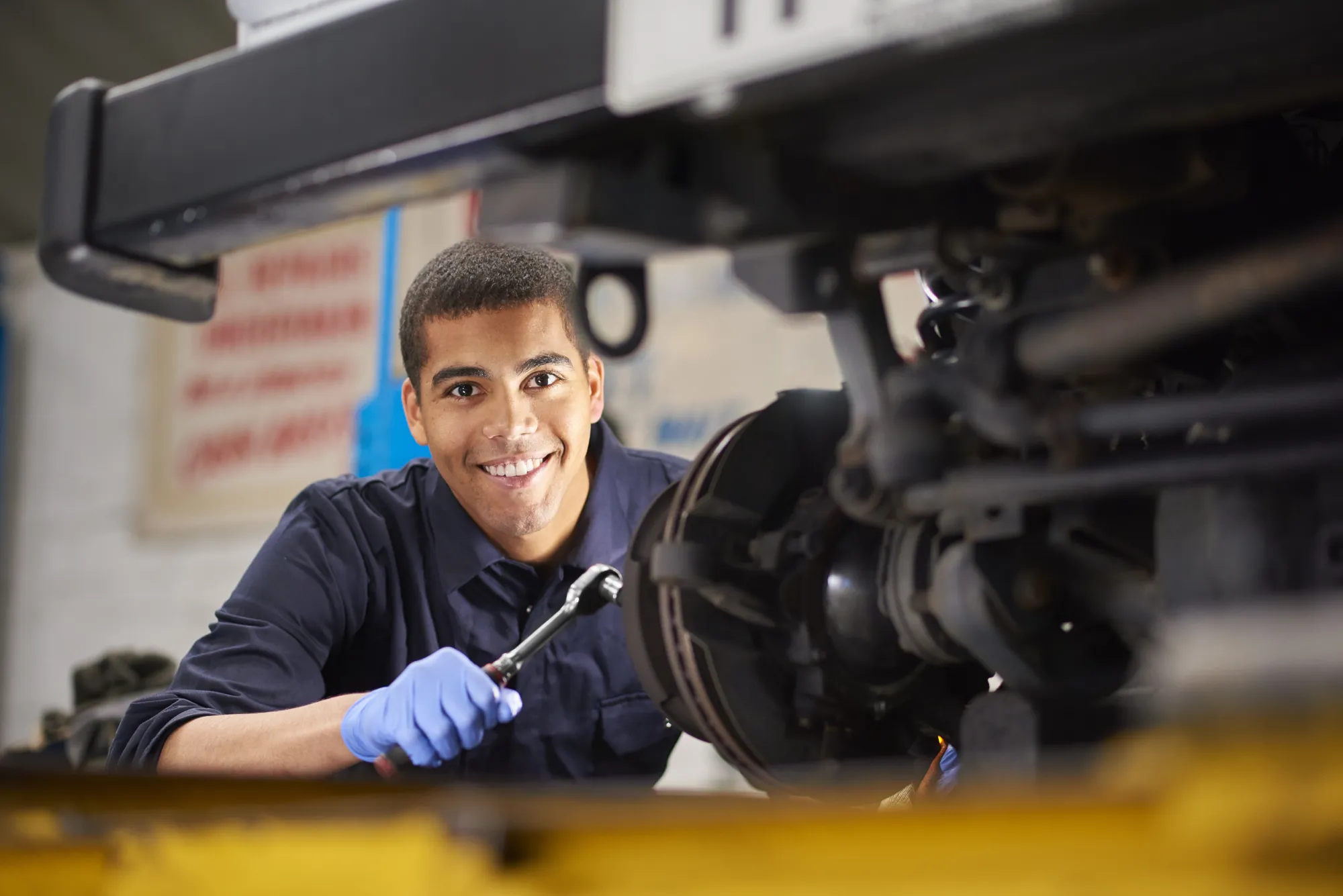
Rotor thickness gets measured, not estimated. Every rotor has its minimum thickness etched right on it, marked MIN TH followed by a value in millimeters. That number is the manufacturer’s, and it is the point where the rotor is no longer safe. A technician gauges at least four separate points around the rotor, because wear is rarely even, and the lowest reading counts for the whole rotor. Below MIN TH, the rotor gets replaced rather than machined.
Rotors get replaced in pairs. If one side of an axle measures under the limit, both come off. Mismatched rotors mean mismatched braking left to right, which is a handling problem as much as a wear problem.
Pads, fluid, hoses, and hardware get eyes on them. Pad thickness, fluid condition and level, flexible hoses and lines, and the caliper hardware that lets everything slide freely are all part of the job. Seized hardware is a common find on vehicles that live in wet air.
A test drive closes it out. Some problems only speak up under load. A pull to one side, a pulsation above a certain speed, a noise that appears only once the brakes are warm: none of that shows itself on a lift.
Worn out rotors are not a cosmetic issue. Run them past the limit and you invite thermal cracking, deformation that brings vibration and noise, more pedal travel, and brake fade that stretches your stopping distance at the exact moment you need it shortest.
Noises And Symptoms You Should Not Wait Out
Sort the sounds this way. A squeal on the first stop of a humid morning that clears in a few stops is the oxide film. A squeak that shows up every time, warm or cold, usually means the pads have worn below their recommended thickness and the wear indicator is doing its job. Grinding, sometimes called brake scrubbing, means pads need replacing now, before they chew up the rotors behind them.
Get it checked promptly if you notice:
- Grinding that persists after the brakes are warm
- A pedal that pulses, or a steering wheel that shakes when you slow down
- A pedal that sinks farther toward the floor than it used to
- The vehicle pulling to one side under braking
- Stopping distances that feel longer than they did a month ago
Waiting turns a pad job into a rotor job, and a rotor job into a caliper job. If you have caught yourself searching for brake repair near me at a red light on Florida Boulevard, that is your answer.
Keeping Corrosion From Getting Ahead Of You
You cannot dehumidify Baton Rouge, but you can keep the film from ever becoming pitting.
Drive the vehicle. The best rust preventive is regular use, since the pads clean the rotors every time you stop. If a second vehicle mostly sits, take it out for a real drive with normal stops now and then.
Park under cover when you can. A garage or carport will not beat the humidity, but it keeps dew and rain off the rotors.
Dry the brakes after water. Coming out of a car wash or off a flooded street, a few gentle stops on the way home wipe the rotors dry instead of leaving them wet in the driveway.
Fold brakes into a routine you already have. The same trip that covers a tire rotation or an oil change on a Baton Rouge summer schedule can cover this. AAA suggests having pads and rotors or drums inspected with every tire rotation, traditionally every 5,000 to 7,500 miles. The wheels are already off, so it adds no extra trip. For service life, AAA puts typical brake life at 25,000 to 65,000 miles depending on how and how much you drive.
Remember the Louisiana state inspection. State law requires periodic official inspection, and that inspection covers the mechanism, brakes, and equipment. Most people around here still call the sticker a brake tag, which tells you how central brakes are to it. A rotor issue you keep putting off becomes a compliance problem on top of a safety one.
The Short Version
Rusty rotors in humid weather are the price of parking a cast iron braking system in south Louisiana. One night of Gulf Coast air hazes the rotors, the pads scrub them clean by the third stop, and the noise meant nothing was wrong. Months of sitting is a different story, and so is grinding that will not quit, a pulsing pedal, or a face that looks pocked instead of polished.
If you are not sure which one you have, a brake inspection in Baton Rouge answers that in a few minutes. If the answer turns out to be pads, rotors, or both, we will walk you through what your vehicle needs and give you a current number for the work before anything starts. Ask us for today’s figure rather than going off something you read somewhere.
Plantation Tire & Auto in Baton Rouge, LA has been helping drivers across East Baton Rouge and the surrounding parishes tell normal noises from real problems for more than 30 years. Bring us the squeal and we will tell you straight which one it is. When you want brake repair in Baton Rouge, or just a second opinion on a noise, we are down the road.