

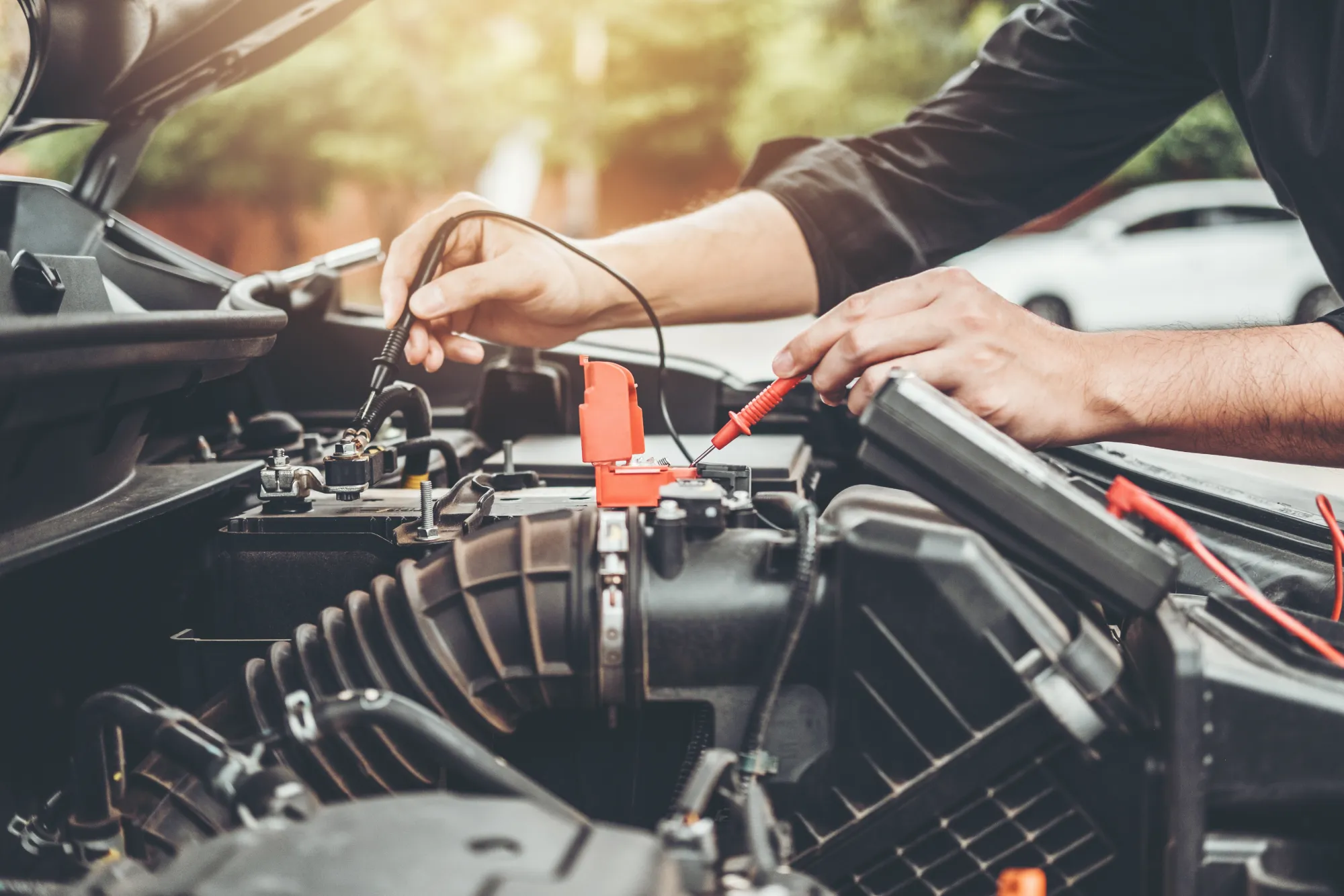
Most people think of an overheating car as a sudden event. One minute you are driving, the next there is steam rolling out from under the hood on the shoulder of I-10. In our experience, that is almost never how it actually happens. The failure that strands you in August was being built all summer, a few degrees at a time, in traffic.
Here is the part that surprises drivers: highway heat is not what wears out a cooling system. Stop-and-go traffic is. If your commute involves crawling on College Drive at 5 p.m. or sitting through three light cycles on Airline Highway, your engine is working under a heat load it was never designed to hold for that long. Let’s walk through what is actually going on in there, what the quiet early warnings look like, and why a cooling system check belongs on your maintenance list well before the temperature gauge ever pegs.
Why Stop-And-Go Heat Is Worse Than Highway Heat
Your radiator cools by moving air through it. At 60 miles per hour, that happens for free, because air is being forced through the radiator core whether the fan runs or not. It is the cheapest cooling your engine will ever get.
Now put that same engine at a dead stop in traffic. There is no air being forced through anything. The only thing moving air across the radiator is the cooling fan, and it is doing the entire job by itself. Meanwhile the engine has not stopped producing heat just because the wheels stopped turning.
Then add air conditioning, which in Baton Rouge is not optional. The A/C condenser sits right in front of the radiator, and it is dumping the heat it pulled out of your cabin into the exact same airflow the radiator needs. So at the worst possible moment, stopped, no ram air, outside air near 90 degrees, you have loaded the compressor and added another heat source in front of the radiator.
That is the whole story of car overheating in Baton Rouge traffic. Not a defect. Just the hardest thing you can ask a cooling system to do, repeated every weekday.
The Baton Rouge Hot Season Is Longer Than You Think
Drivers tend to treat summer heat like a two-week event to get through. The climate data says otherwise. According to Weather Spark, Baton Rouge’s hot season runs 4.3 months, from roughly May 17 to September 26, which is the stretch where the average daily high stays above 85 degrees. July and August both average a daily high of 90 degrees.
Four months is not a heat wave. It is a season of sustained load. That distinction matters because heat damage is cumulative. A cooling system does not fail from one bad afternoon; it fails from a few hundred of them stacked back to back, which is exactly what a Louisiana summer delivers.
It is also why our advice here differs from what you would read on a national auto blog. The “normal” maintenance schedule in your owner’s manual was not written with a Gulf South commute in mind. It is the same reason we tell customers that oil change intervals in Baton Rouge heat deserve a second look rather than a blanket number.
What The Heat Actually Does, Part By Part
The cooling system is not one component. It is six or seven things that all age differently, and heat is what consumes each of them.
The coolant itself. Coolant is not just liquid that carries heat. It is loaded with corrosion inhibitors that protect the metal inside your engine, radiator and heater core. Those additives deplete. As Cars.com notes, coolant becomes more acidic over time and loses its rust-inhibiting properties, which is what starts corrosion inside the system. The coolant can still look fine in the reservoir while having lost most of its protective value.
The hoses. Rubber hardens and loses flexibility with heat cycling. Some hoses swell instead, going soft and spongy where they clamp on. Either way, the failure point is usually not the middle of the hose you can see. It is the last inch at the fitting, which is also the hardest spot to eyeball.
The radiator. Fins get packed with road grit, bug debris and Louisiana pollen, and the internal passages narrow as corrosion products circulate. A radiator that is 20 percent blocked works perfectly well on the highway and quietly runs out of margin in traffic.
The thermostat. Its job is to open and let coolant flow to the radiator once the engine reaches temperature. A thermostat that sticks partly closed does not throw a dramatic warning. It just means the engine runs hotter than it should under load, all the time.
The cooling fan. This is the big one for stop-and-go driving, because in traffic the fan is your only cooling. When the fan or its control circuit fails, everything feels normal on the highway. The problem only shows up at idle, which is to say, the problem only shows up in traffic, exactly when you have no backup.
The cap. The most overlooked part on the list, and the next section explains why it matters more than it looks.
Why Pressure Is The Entire Safety Margin
This is the piece almost nobody explains to customers, and it is the reason a small, invisible problem turns into a tow.
A standard 50/50 mix of water and ethylene glycol boils at 223 degrees with no pressure on it. That is not much headroom for an engine working hard on a 90-degree afternoon. So the system is sealed and pressurized, and pressure raises the boiling point, roughly 3 degrees for every 1 psi. Most modern systems run somewhere between 13 and 16 psi, with the exact rating printed right on the cap. At 15 psi, you have added about 45 degrees, pushing the boiling point to around 268 degrees.
Read that again, because it reframes the whole problem. Your engine’s protection against boiling over is not the coolant alone. It is the coolant plus the pressure holding it together. As DeWitts Radiator puts it, the cap does not control engine temperature at all. It raises the boiling point so the system can run hot without vaporizing and losing coolant.
Which means a cap that no longer seals, a hose seeping at a clamp, or a pinhole in the radiator does not just cost you a little coolant. It costs you your margin. The system can be down 30 or 40 degrees of protection while your gauge still reads normal on the highway. Then you hit traffic, and the buffer that used to absorb it is gone.
The Quiet Symptoms That Come Before The Steam
By the time you see steam, the diagnosis is easy and the repair is not. These are the signs that show up weeks or months earlier, and every one of them is easy to talk yourself out of.
- The needle sits a little higher than it used to. Not in the red. Just a needle-width past the spot where it always lived, and it drops back to normal once you get moving on the interstate. That is the airflow-versus-heat-load story showing up on your dash, and it is the single most useful early warning you get.
- A sweet, syrupy smell. Sometimes in the cabin, sometimes just standing near the front of the vehicle after you park. Coolant escaping and vaporizing on something hot smells distinctly sweet. Nothing else under your hood smells like that.
- Weak or lukewarm heat at idle. People file this under winter annoyance and never mention it. It is actually a coolant circulation and heater core clue, and it points at the same system that will strand you in July.
- Crusty white or colored residue near hose ends and fittings. That is dried coolant marking the exit point of a slow seep.
- You have topped off the reservoir more than once. This one matters most. Coolant is not consumed the way fuel is. In a sealed system, a level that keeps dropping means it is going somewhere, and topping it off treats the symptom while the leak keeps growing.
- You never hear the fan cycle on. Sit in your parked car with the A/C running and listen. If the fan never audibly kicks in, that is worth a look before August.
Coolant Service Intervals And What “Severe Duty” Really Means
The honest answer to “how often do I need coolant service?” is that it depends enormously on your vehicle, and the spread is wider than most drivers imagine.
AAA’s guidance is to have the cooling system flushed and new coolant installed when the manufacturer recommends it, which depending on coolant type is typically every two to five years. Mileage figures vary even more by brand. Cars.com documents Hyundai specifying replacement after the first 60,000 miles and every 30,000 miles after that; some Mercedes-Benz models calling for every 30,000 miles while others are rated at 120,000 miles or 12 years and even 150,000 miles or 15 years; and Chevrolet specifying a change at 150,000 miles regardless of how the vehicle is driven.
So the first step is your owner’s manual, not a blanket rule. But there is a catch that applies to nearly everyone reading this. Manufacturers publish two schedules, normal and severe service, and they advise draining, flushing and changing coolant more often on vehicles in severe service, such as frequent towing, because towing generates more heat.
Look at what qualifies: sustained heat, short trips, stop-and-go traffic, towing. That is a description of driving in Baton Rouge. The truck owner who tows a boat to False River most weekends is on the severe schedule and usually has no idea. So is the parent doing a four-mile school run twice a day in August.
There is also a middle option people do not know exists. Coolant can be tested rather than simply replaced on a calendar. Vehicles past roughly 50,000 miles should have the coolant checked periodically for acidity and for signs of rust and leaks, which tells you whether it still has protective life left instead of guessing.
What A Cooling System Pressure Test Tells A Technician
When you bring in a vehicle with any of the quiet symptoms above, the pressure test is how a good technician turns a hunch into an answer. This is squarely auto repair and diagnostic work, and it is one of those jobs that belongs with a professional rather than a driveway guess, much like the other car maintenance best left to the pros.
A hand pump attaches where the cap goes, and the system is pumped up to the cap’s rated pressure, no higher. Then it just gets watched. A healthy sealed system holds its rated pressure; standard industry procedure has it hold for at least two minutes, and the gauge is monitored over a longer window, around 30 minutes, to catch anything significant.
The useful part is that the gauge does not just say leak or no leak. It sizes the leak. A quick drop means something substantial. A slow bleed-down means a small one, a weeping fitting or a pinhole you would never spot with a flashlight. That is how a leak gets found while it is still a minor repair instead of after it has emptied the system on Perkins Road.
The cap gets tested separately, held at its rating for about a minute. A cap that cannot hold its number is quietly costing you all that boiling-point margin from earlier, and it is one of the smallest parts in the system.
And there is one result that tells a technician something important: pressure falls, but no external leak can be found anywhere. When coolant is disappearing with nowhere outside to go, a failed head gasket leaking coolant into the cylinders or oil passages becomes the prime suspect. Knowing that early, before the engine is run hard for another month, changes the entire outcome of the repair.
While the system is open, it is also worth remembering that heat is hard on more than coolant. AAA reports summer heat takes a greater toll on car batteries than sub-freezing winter temperatures, and lists headlights dimming at idle among the signs of a battery going bad, another thing best caught in the bay rather than in a parking lot.
When To Bring It In
Simple triggers, no guesswork required:
- The temperature gauge sits higher than its normal spot, even a little
- You smell anything sweet after driving or parking
- You have added coolant more than once this year
- Heat from the vents is weak at idle
- You have never had coolant service and you do not know when it was last done
- You tow, idle in traffic daily, or drive mostly short trips
Any one of those is worth an hour in the bay. All of them are cheaper to investigate now than to repair in the median of Airline Highway.
Cooling system work also varies a lot by vehicle. A flush is one thing; a radiator, a fan assembly or a water pump on a specific engine is another, and anyone naming a number without knowing what you drive is guessing. We would rather look at your vehicle and give you the current figure for the actual work it needs.
That is what we have been doing here for more than 30 years. Plantation Tire & Auto in Baton Rouge, LA can pressure test your cooling system, check your coolant’s real condition rather than its color, and tell you straight whether you need service now or are fine until next season.
Get A Current Quote On Your Cooling System
Ready to stop guessing about your cooling system? Bring it to Plantation Tire & Auto in Baton Rouge, LA and we will test it, tell you what it needs, and give you the current price for your specific vehicle.